Pet Loss Statistics: The State of Pet Loss in America (2026 Report)
 By Pham PhamNovember 07, 2026
Table of contents
The leash is still on its hook by the door. When a pet is gone, the house goes quiet in a way nobody else seems to hear, and it's easy to wonder whether you're grieving too much. You're not, and you're in very large company.
Pet loss statistics show how common this grief is. About 95 million U.S. households have a pet, 97% of owners call their pet family, and in one study 85.7% of owners had grief symptoms after losing a dog or cat, with 22.4% still grieving a year later. No U.S. state requires pet bereavement leave yet.
Last updated: November 2026. Public data from APPA, Pew Research Center, peer-reviewed studies and state labor agencies, plus our own count of 71 public posts by grieving dog owners.
1. Key pet loss statistics at a glance
- 95 million U.S. households owned at least one pet in 2025, including 71 million with a dog and 53 million with a cat (APPA).
- 97% of pet owners say their pet is part of the family, and 51% say a pet is as much a part of the family as a human member (Pew Research Center, 2023).
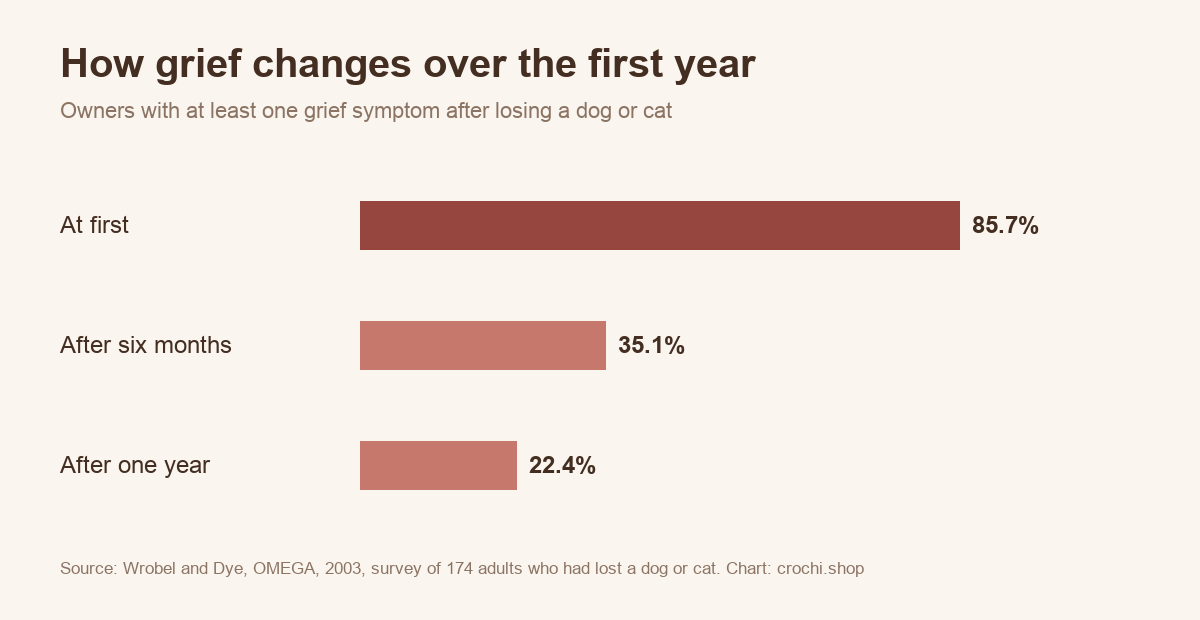
- 85.7% of owners had at least one grief symptom after losing a dog or cat. 35.1% still did after six months, and 22.4% after one year (Wrobel and Dye, 2003).
- 7.5% of people who lost a beloved pet met the criteria for prolonged grief disorder, close to the rate after losing a close friend, 7.8% (Hyland, 2026, UK sample).
- No U.S. state requires private employers to offer pet bereavement leave. In a 2021 Banfield survey, 37% of employers said they offer it anyway.
Behind every one of these numbers is a person who still says their pet's name out loud. If the loss feels bigger than people around you expect, the data is on your side.
2. How many Americans have a pet, and how long do pets live?
About 95 million U.S. households owned at least one pet in 2025, according to the American Pet Products Association. Dogs live in 71 million of those homes (53% of U.S. households) and cats in 53 million (39%). Those pet ownership statistics mean that losing a pet is one of the most common family losses in America.
| Measure | Figure | Source |
|---|---|---|
| U.S. households with at least one pet, 2025 | 95 million | APPA |
| Households with a dog, 2025 | 71 million (53%) | APPA |
| Households with a cat, 2025 | 53 million (39%) | APPA |
| U.S. pet industry spending, 2025 | $158 billion | APPA |
| Americans who own a pet, 2023 | 62% | Pew Research Center |
| Pet owners who say their pet is part of the family | 97% | Pew Research Center |
| Pet owners who say their pet is as much family as a human member | 51% | Pew Research Center |
Sources: APPA 2026 State of the Industry report (2025 data), released March 2026; Pew Research Center survey of 5,073 U.S. adults, April 2023.
A dog in the U.S. lives about 12.7 years on average, and a cat about 11.2 years, according to a 2023 study in Frontiers in Veterinary Science that used records from Banfield Pet Hospital clinics from 2013 to 2019. Small dogs had the longest life expectancy at 13.5 years, and giant breeds the shortest at 9.5 years.
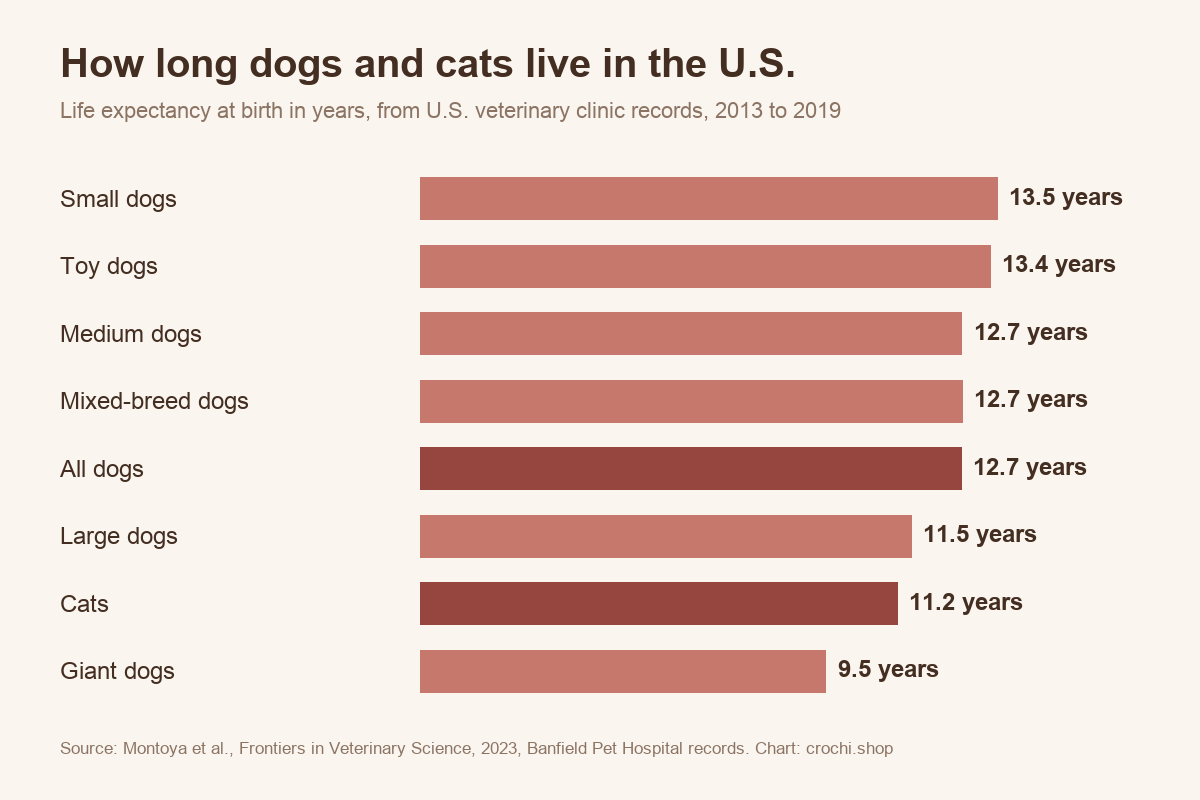
Our read: a dog's whole life fits inside a slice of ours, so many people say goodbye to more than one dog or cat in a lifetime. Each goodbye takes a whole chapter of ordinary days with it. Of course it hurts.
3. How long does grief last after losing a pet?
For most people, grief after losing a pet softens over months, but for a real minority it stays for a year or longer. In a study of 174 adults who had lost a dog or cat, published in OMEGA, 85.7% had at least one grief symptom at first, 35.1% still did at six months, and 22.4% at one year. The stronger the attachment to the pet, the longer and heavier the symptoms tended to be.
Other studies point the same way. In a survey of 106 people at a U.S. veterinary clinic, published in the Bulletin of the Menninger Clinic in 2009, about 20% had significant features of grief after losing a pet, and for about 30% the sadness lasted six months or more. Very severe reactions were rare.
The newest evidence compares pets with people directly. A 2026 study in PLOS ONE of 975 adults in the United Kingdom found that 32.6% had lost a beloved pet, and 21.0% of them named that loss as the most distressing loss of their life, even though almost all had also lost a person. Among people who lost a pet, 7.5% met the criteria for prolonged grief disorder, which means grief that stays intense and gets in the way of daily life for a long time.
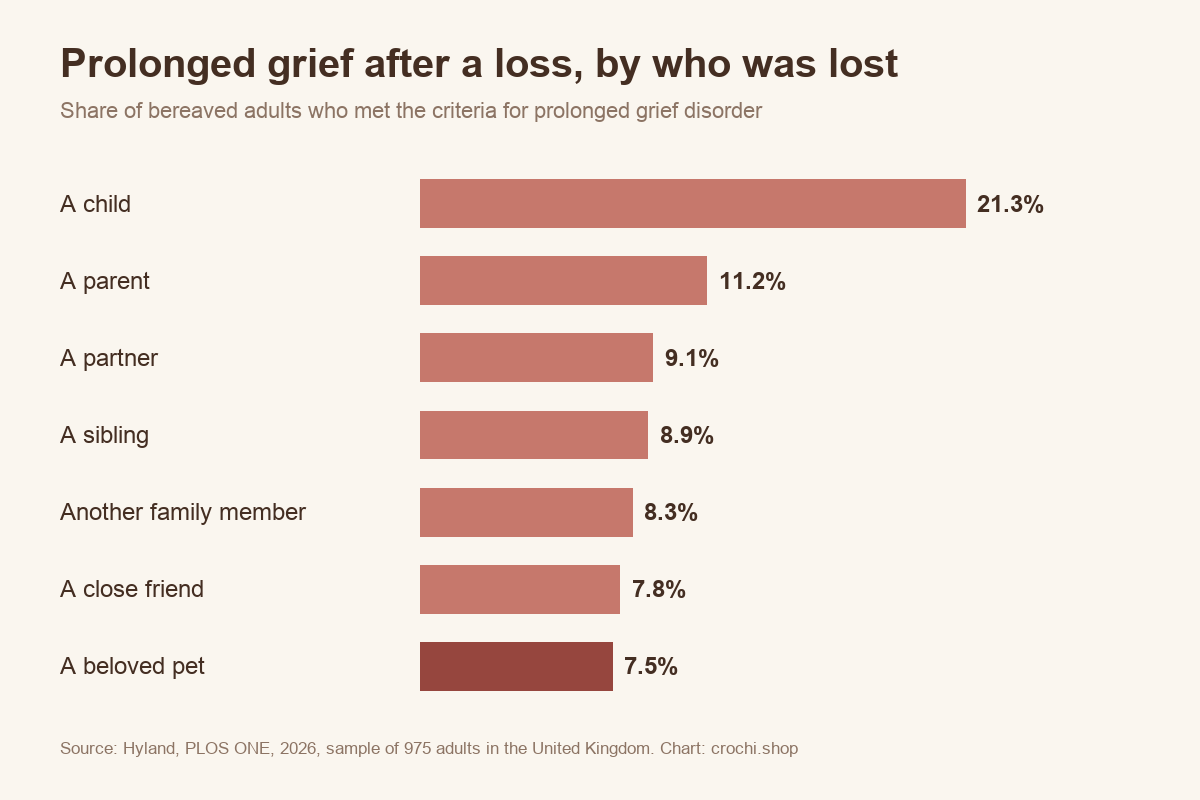
That 7.5% sits right next to the rates after losing a close friend (7.8%) or a grandparent, cousin, aunt or uncle (8.3%). The study's author found that the symptoms look the same whether the loss is a person or a pet, and wrote that they "manifest in the same way regardless of the species." A smaller study in Death Studies (2019) also found no significant difference in grief severity between people who lost a human and people who lost a pet.
If you're still missing them months later, nothing is wrong with you. If the weight feels like too much to carry alone, here's a list of free pet loss support hotlines and groups in the U.S.
4. What makes losing a pet harder?
A sudden loss and a very close bond are both linked to heavier grief. In a 2026 study of 4,902 bereaved pet owners in the Journal of the American Veterinary Medical Association, an unexpected loss was tied to stronger grief, depression and anxiety, and so was describing the pet as a "partner or soulmate" rather than a best friend.
The same study found that euthanasia was linked to lower grief and lower depression, and that being in the room at the end wasn't linked to any outcome either way. A separate Dog Aging Project study compared 70 owners whose dog was euthanized with 70 whose dog's life ended without assistance, and found no significant difference in the positive or negative experiences they described.
For anyone carrying a question about the decision, those findings may help a little. In this research, choosing a gentle goodbye wasn't linked to heavier grief, and not being there doesn't mean you loved them less. If the guilt keeps coming back, this letter about the guilt after putting your dog down might feel familiar.
There's one more weight many people carry: the feeling that others don't take this loss seriously. It shows up when a coworker says "it was just a dog," or when there's no time off to grieve. Half of pet owners say their pet is as much family as any person, but workplaces and laws haven't caught up.
5. Do employers offer pet bereavement leave?
Some employers offer pet bereavement leave, but no U.S. law requires it. As of April 2026, several states had seen bills on pet-related leave, but "none has yet been enacted into law," according to a review by the law firm Squire Patton Boggs. Even in states with bereavement leave laws, the family members covered are people.
| Where | What the rule says | Are pets covered? |
|---|---|---|
| California | Up to 5 days of bereavement leave for employees of businesses with 5 or more workers | No. The covered family list is people, though an employer may choose to allow more |
| Illinois | Up to 2 weeks (10 workdays) of unpaid bereavement leave, up to 6 weeks for several losses in a year | No. Covered family members are people |
| Maryland | Senate Bill 260 (2020) would have allowed paid leave after the loss of a pet | Proposed only, not passed |
| Missouri and Illinois | Bills introduced (Missouri HB 3207, Illinois SB 1670) to add pet bereavement leave | Proposed only, not law as of April 2026 |
Sources: California Civil Rights Department, Illinois Department of Labor, Squire Patton Boggs. We found no federal or state law that gives employees time off for the loss of a pet.
Inside companies, the picture is mixed. In a 2021 Banfield Pet Hospital survey conducted by OnePoll, 37% of employers said they offer pet bereavement leave. The release gives no sample size, so treat that as a rough picture. Public opinion is split too: when YouGov asked 3,297 U.S. adults in 2019 whether bereavement leave should cover the loss of a pet, 35% said yes, 45% said no and 20% weren't sure.
If you need time off after losing your pet, here are a few gentle ways to ask:
- Check your handbook first. Look under bereavement, personal days and sick time. Some policies name pets.
- Tell your manager plainly. "I lost my dog of 14 years yesterday, and I need a day" is enough. You don't owe anyone more detail than that.
- Ask for what would actually help. A full day, a half day, a quiet day working from home, or a later start.
- Plan ahead if a goodbye is scheduled. Asking for that day and the next one is a reasonable request.
Needing time to grieve a pet isn't unprofessional. It's a normal response to losing someone you saw every single day.
6. What do grieving dog owners keep and share?
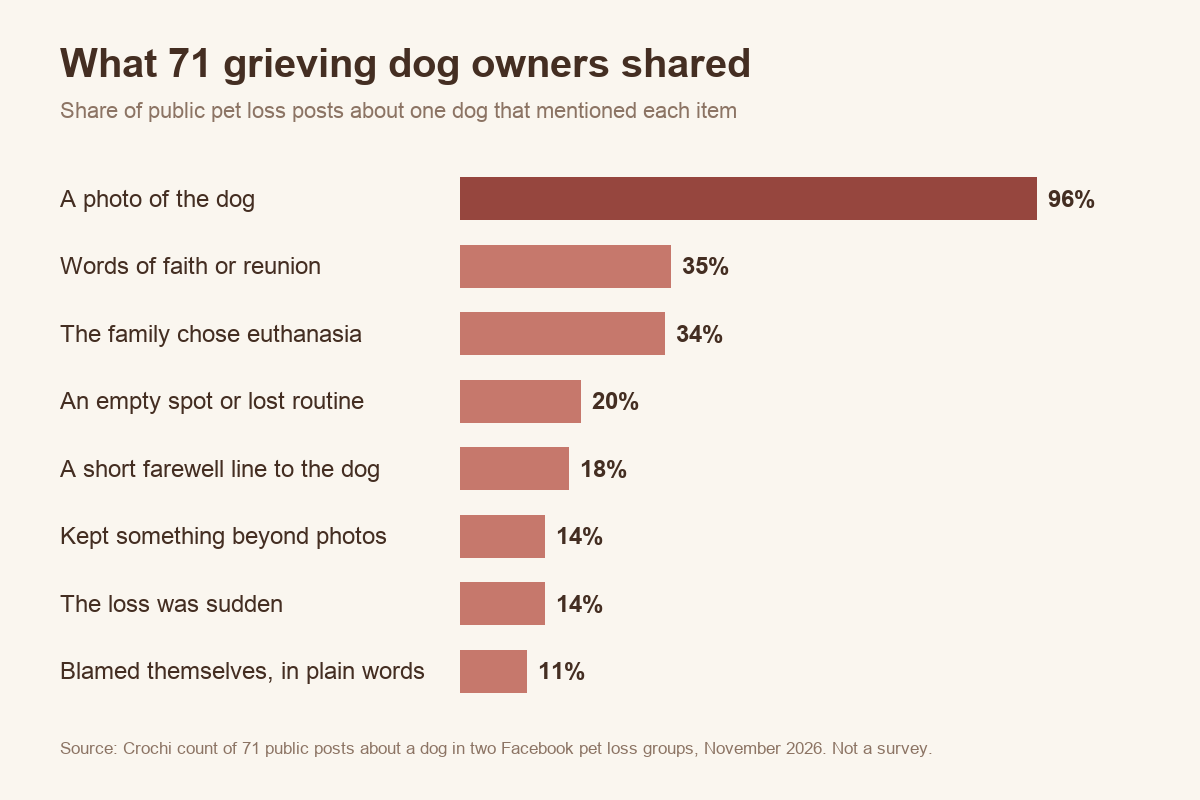
Grieving dog owners share photos first and keep small, specific things. In November 2026, we read and counted 92 unique public posts in two Facebook pet loss groups by hand. 71 were about one specific dog, and almost all of those, 68 of 71 (96%), included a photo. This is our own observation, not a survey, and the method is in section 9.
| What the post said | Posts | Share |
|---|---|---|
| Included at least one photo of the dog | 68 of 71 | 96% |
| Used words of faith or reunion | 25 of 71 | 35% |
| Said the family chose euthanasia | 24 of 71 | 34% |
| Described an empty spot or a lost routine at home | 14 of 71 | 20% |
| Wrote a short farewell line to the dog | 13 of 71 | 18% |
| Named the Rainbow Bridge | 11 of 71 | 15% |
| Described keeping something beyond photos | 10 of 71 | 14% |
| Said the loss was sudden | 10 of 71 | 14% |
| Named cancer as the cause | 9 of 71 | 13% |
| Said in plain words they blamed themselves | 8 of 71 | 11% |
| Wrote the dog's birth date and last day | 7 of 71 | 10% |
6.1 What people kept beyond photos
Beyond photos, 10 of 71 dog posts (14%) described keeping something to remember the dog by: two tattoos, two sets of ashes brought home, two resting places in the yard, two pieces of memorial artwork, a recording of the dog's soft snoring, and a bed shared with the dog's favorite stuffed toys.
Each keepsake could only belong to one dog. If all you've done so far is scroll through photos, that's enough. Most people start there.
6.2 How old the dogs were
Most of the dogs were old. Among 31 dogs whose age was given or could be worked out, the median age was 14 years, 58% were 13 or older, and the oldest was 20. Nine were under 10, and losing a young dog brings its own shock. People may mention age more often when a dog was very old, so the true median could be lower.
6.3 When people reached out
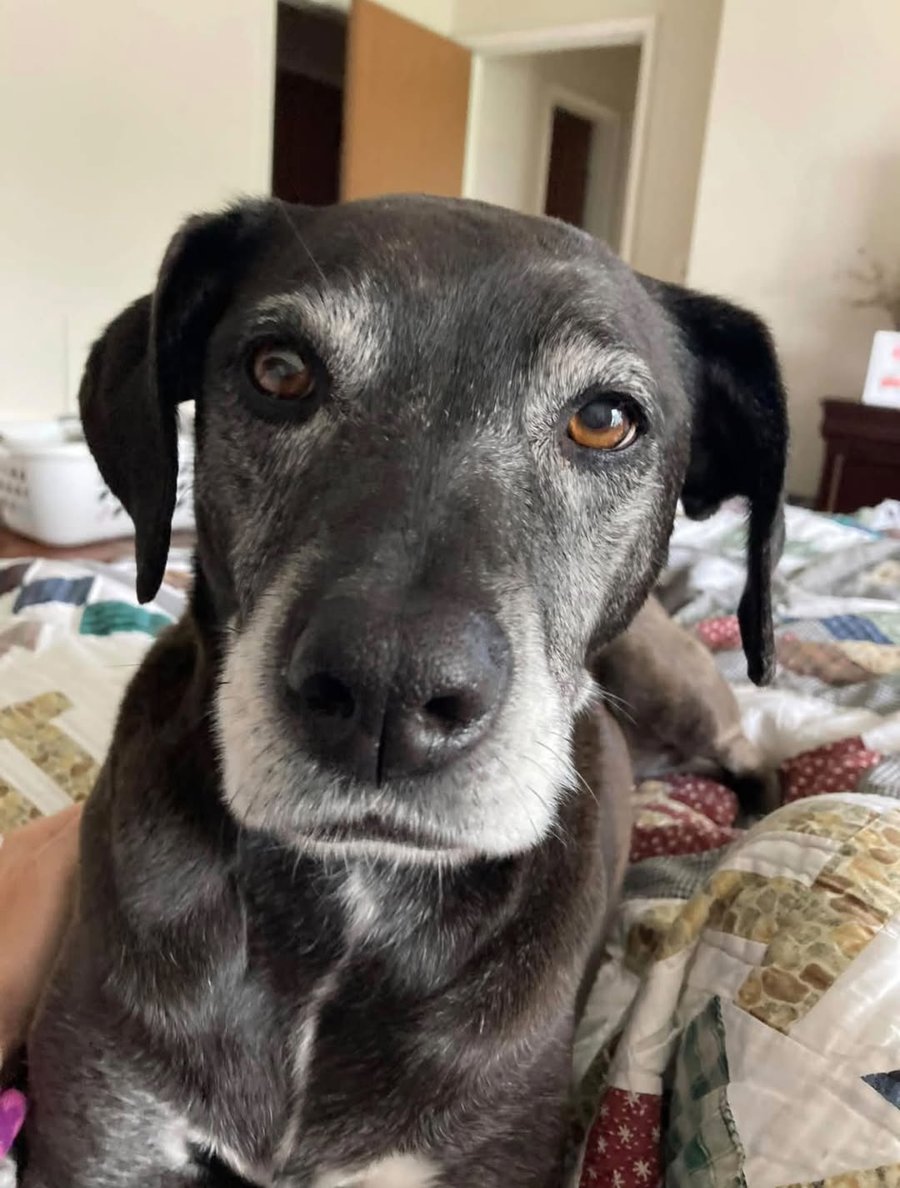
Most people reached out within days. Of 53 dog posts that said when the loss happened, 31 (58%) were written within the first week and 47 (89%) within about two months. Ten were written the same day. There was a long tail too: four posts came a year or more later, one of them six years after the goodbye.

6.4 What hurt the most
The hardest things people named were the decision to say goodbye, the empty places at home and the questions that came afterward. 14 of 71 (20%) described an empty spot or a broken routine: the dog bed, the doorway, the kitchen floor during cooking, the first walk of the morning. Eight said plainly that they blamed themselves, likely an undercount.
6.5 How people said goodbye
People most often said goodbye with words of faith or reunion, in 25 of 71 posts (35%). Many posts read almost like a headstone: the dog's name, a birth date and last day, and one short line spoken straight to the dog, such as "run free" or "until we meet again." A name, two dates and one line can hold fourteen years.
7. What this means for you
7.1 If you just lost your pet
If you just lost your pet, the numbers mostly say one thing: what you're doing is what grieving people do. Most people reach out within the first week, most of them share a photo, and many are still talking about their pet a year later. You're allowed to take your time.
You don't have to keep anything yet, and you don't have to explain your grief to anyone who doesn't get it. Some people find comfort in a small way to remember their pet, and some want to talk to someone who understands first. If a holiday is coming, here's a gentle letter about the first Christmas without your dog, and if a friend asks how to help, you could share our guide on what to give someone who lost their dog.
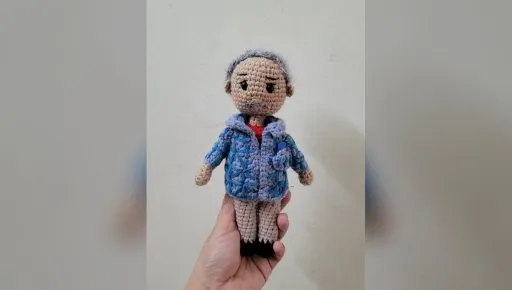
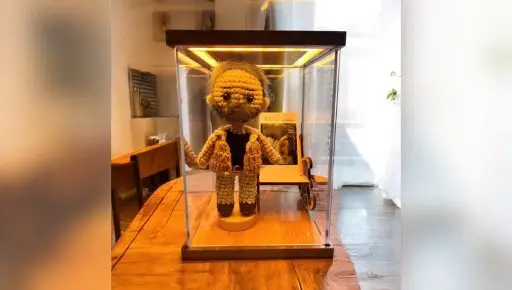
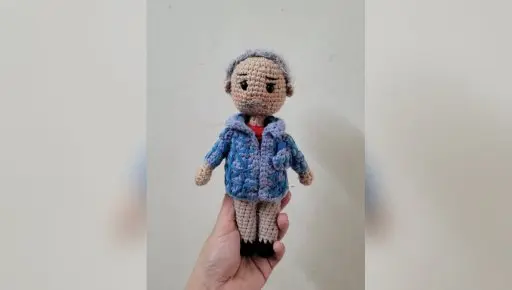
And if, at some point, you'd like something you can hold, Crochi makes handmade crochet dolls from your photo. A crochet keepsake made to look like your dog is one gentle way to keep them close, with a free preview photo before it ships. If you're not ready for a reminder yet, that's okay. The photos will wait.
7.2 If you work at a vet clinic or a pet crematory
- Reach out in the first week. 58% of the grieving owners we counted posted within seven days of the loss. A short card or call in that window reaches people when they're looking for someone who understands.
- Remember the anniversaries. In one study, 22.4% of owners still had grief symptoms after a year. A note on the first anniversary can mean more than anything sent in the first week.
- Make room for the photo and the small things. Almost every owner we counted shared a photo, and keepsakes were very specific: a paw print, a recording, a collar.
- Keep support numbers ready. A printed list of pet loss hotlines and groups is easy to hand over at a hard moment.
- Speak to the decision without judgment. One large study linked euthanasia with lower grief, not higher. Many owners still need to hear that their choice was made with love.
If you write a workplace policy, naming pets in your bereavement or personal leave policy, even for one day, takes a quiet worry off people at one of the hardest moments of their year.
8. Questions people often ask
8.1 How many pets are there in the U.S.?
About 95 million U.S. households owned at least one pet in 2025, according to the American Pet Products Association. That includes 71 million households with a dog and 53 million with a cat.
8.2 Is it normal to grieve a pet as much as a person?
Yes. In a 2026 UK study, about one in five people who had lost both a pet and a person said the pet's loss was the most distressing, and prolonged grief was about as common after losing a pet as after losing a close friend. It's a different loss, not a smaller one.
8.3 How many days off should you take after losing a pet?
There's no legal standard in the U.S., so it depends on your employer and on what you need. Even one day can help, and some people add a few flexible or work-from-home days after it. If your handbook doesn't mention pets, it's still reasonable to ask for a personal or sick day and say why.
8.4 Is it normal to still grieve a dog a year later?
Yes. In one study, 22.4% of owners still had grief symptoms a year after losing a dog or cat, and in our own count, four grieving owners wrote about their dog a year or more later. Grief doesn't follow a calendar, and anniversaries often bring it back.
9. Sources and methodology
This report combines public data with one small dataset of our own. Every public figure was checked on the publisher's page or in the study's published abstract.
9.1 Public sources
- Pet ownership: American Pet Products Association, 2026 State of the Industry report (2025 data); Pew Research Center, survey of 5,073 U.S. adults, April 2023.
- Life expectancy: Montoya et al., Frontiers in Veterinary Science, 2023, Banfield Pet Hospital records from 2013 to 2019.
- Grief research: Wrobel and Dye, OMEGA, 2003 (174 adults); Adrian, Deliramich and Frueh, Bulletin of the Menninger Clinic, 2009 (106 adults); Lavorgna and Hutton, Death Studies, 2019 (50 adults, Australia); Hyland, PLOS ONE, 2026 (975 adults, UK); Kogan, Packman, Currin-McCulloch and Bussolari, Journal of the American Veterinary Medical Association, 2026 (4,902 owners); Ryave et al., Journal of the American Veterinary Medical Association, 2026 (Dog Aging Project, 140 owners).
- Pet bereavement leave: Banfield Pet Hospital and OnePoll, March 2021; YouGov, November 2019; California Civil Rights Department; Illinois Department of Labor; Squire Patton Boggs, April 2026.
We left out widely repeated figures we couldn't trace to an original source, such as a percentage of owners who feel guilty after euthanasia. The charts were redrawn by us from the published figures, and anything labeled "Our read" is our own take.
9.2 How we counted the 71 posts
- Source. Public posts in two Facebook pet loss groups, "Grief and support for loss of a beloved pet" (about 530,000 members) and "Rainbow Bridge Society" (about 214,000 members), read on November 6 and 7, 2026.
- Sample. We saved 93 posts with their text and photos. One appeared twice, leaving 92 unique posts. We set aside 9 general posts, leaving 83 about one animal: 71 dogs, 7 cats, 1 ferret, 1 llama and 3 unclear.
- Coding. Each dog post was read in full and coded by hand for a fixed list, from age and timing to keepsakes. A post counted only when it said the thing clearly. A short script tallied the codes and flagged disagreements with a keyword search for a second read. Age counted only when stated or calculable from dates.
People who write in a grief group are not a random sample of dog owners, so treat the percentages as a picture, not a rate. We don't name anyone, human or dog, or quote the posts, and the photos are used with permission.
10. How to cite this report
You're welcome to use the charts and tables in this report with a link back to this page. A citation could look like this:
"Pet Loss Statistics: The State of Pet Loss in America (2026 Report)," November 2026, https://crochi.shop/articles/pet-loss-statistics
If you're quoting a single public figure, please credit the original source too, such as APPA, Pew or the study's authors. Journalists and researchers who would like the anonymized counts from our 71 posts can write to support@crochi.shop. We'll update this report at the same address when new data comes out.
Thank you for reading this far. Whatever you're holding on to right now, a photo, a collar, a voice memo or the habit of glancing at their spot on the couch, it counts. Take good care.